You’re told to research the schools on your list. Yorra brings event experience, potential departures, returning athletes, and incoming classes together around your graduation year. Understand the team’s event depth, explore where gaps could emerge, and see where your strengths might matter.
Go into the next conversation with better questions.
Less piecing it together. More knowing what to ask.
INSIDE YORRAClemson · Beam
HS 2028 example · First NCAA season 2029
Experience leaving is only part of the picture. Look who’s coming before you assume there’s a gap.
A QUESTION FOR THE COLLEGE COACHING STAFF
“Which events are you prioritizing for my class, and where else could I contribute?”
UNDERSTAND WHERE YOU COULD CONTRIBUTE
Your strongest event is a starting point.
A college coaching staff may love your beam and want to understand what else you could contribute. Their priorities may shift as recruits commit.
Start with your strongest event, then explore the others. Where does the team have depth? Where could gaps emerge by the time you arrive? Could your strengths help address them? Use the research to prepare that conversation with the college coaching staff, not to assume you know their recruiting needs.
TAKE THE LEGWORK OUT OF SCHOOL RESEARCH
“Do your research.” Here’s where to start.
Follow a 2028 recruit’s research, from historical experience to the class ahead. Spend less time assembling information and more time preparing a useful next conversation.
Narrated walkthrough using actual product screenshots. Includes HS2028 and HS2027 examples. Athlete names hidden. Read transcript.
FOLLOW THE RESEARCH
“Beam is my strength. Where could I contribute?”
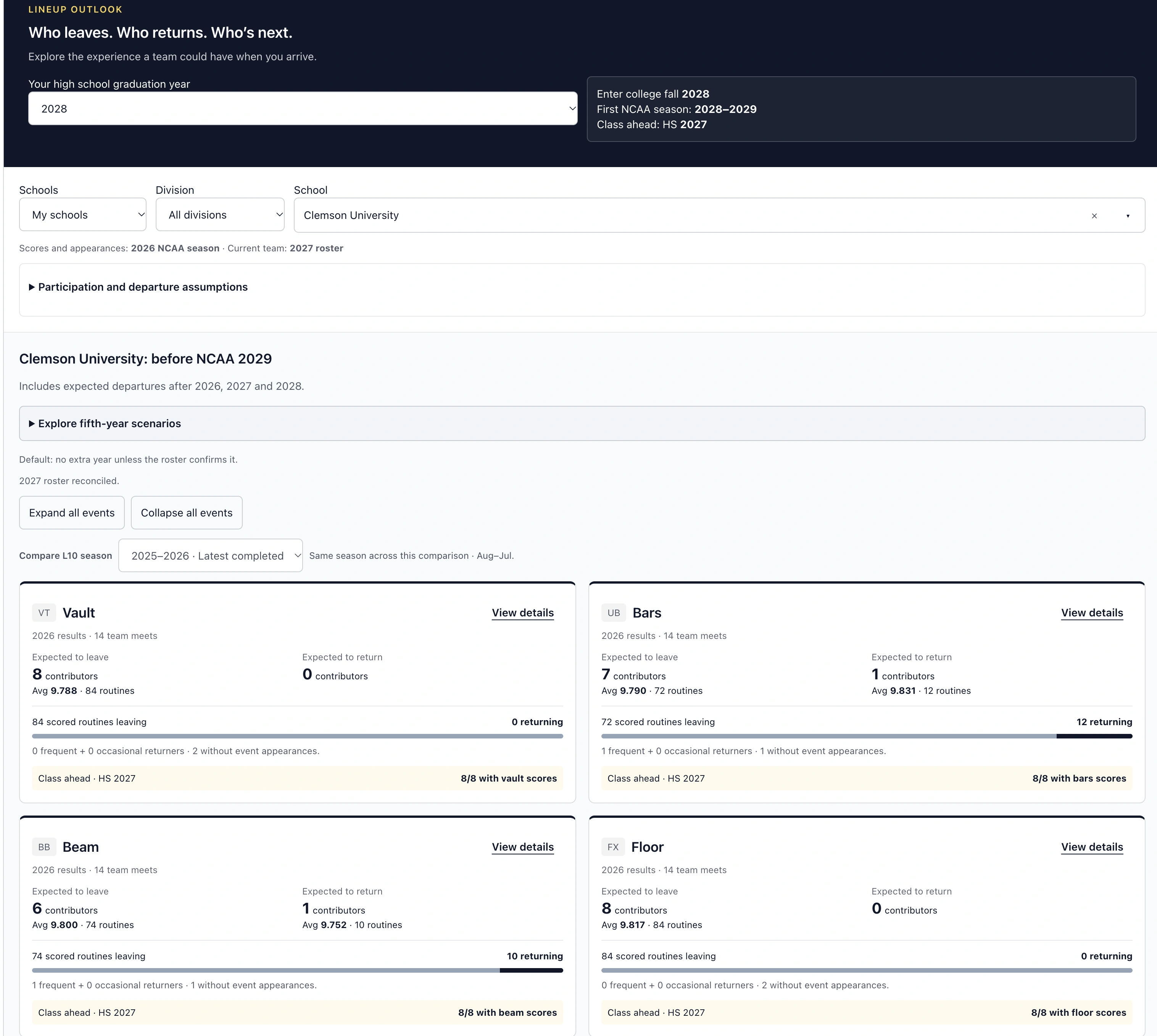
A team can have plenty of athletes without the same experience or depth on every event. Look at the experience leaving, the athletes returning, and the class already on its way.
Actual Yorra screens. Athlete names blurred for this public preview.
Start with an event. Not a headcount.
For this HS 2028 recruit, six athletes with recorded 2026 beam results are expected to leave before her first NCAA season in 2029.
That’s historical experience to investigate, not six available lineup spots. Start here, then look at the returning roster and incoming classes.
THE BETTER QUESTION
What experience remains, and who else could contribute?
Actual Lineup Outlook screen inside Lineup Explorer
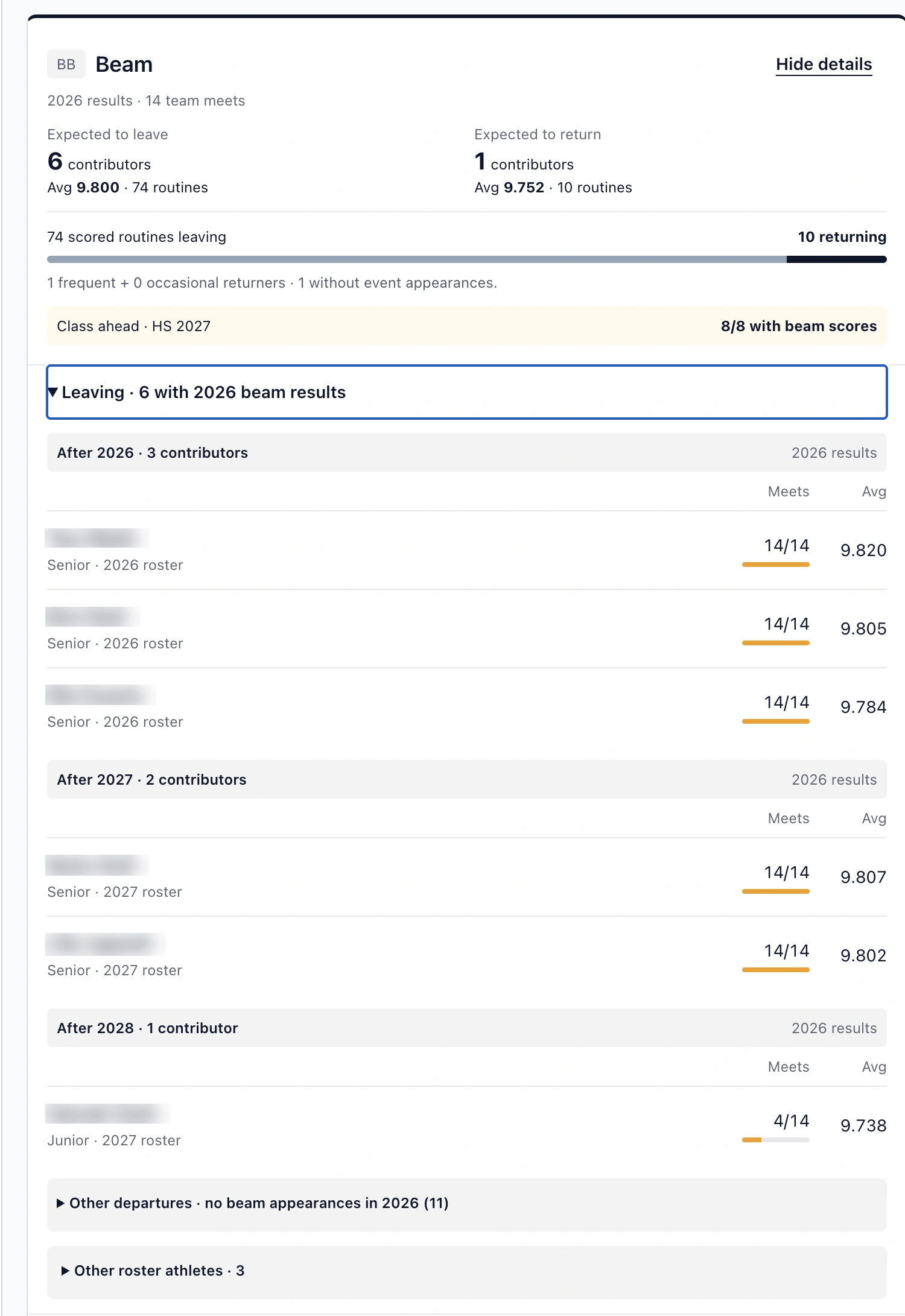
See what’s leaving. Not just who.
The departure view groups athletes by when they are expected to leave. It also shows how often they competed and their recorded event averages.
That separates regular contributors from occasional appearances, without treating every departing athlete as an open spot.
THE BETTER QUESTION
Is the team losing regular contributors, occasional routines, or both?
Expected departures · Historical 2026 results
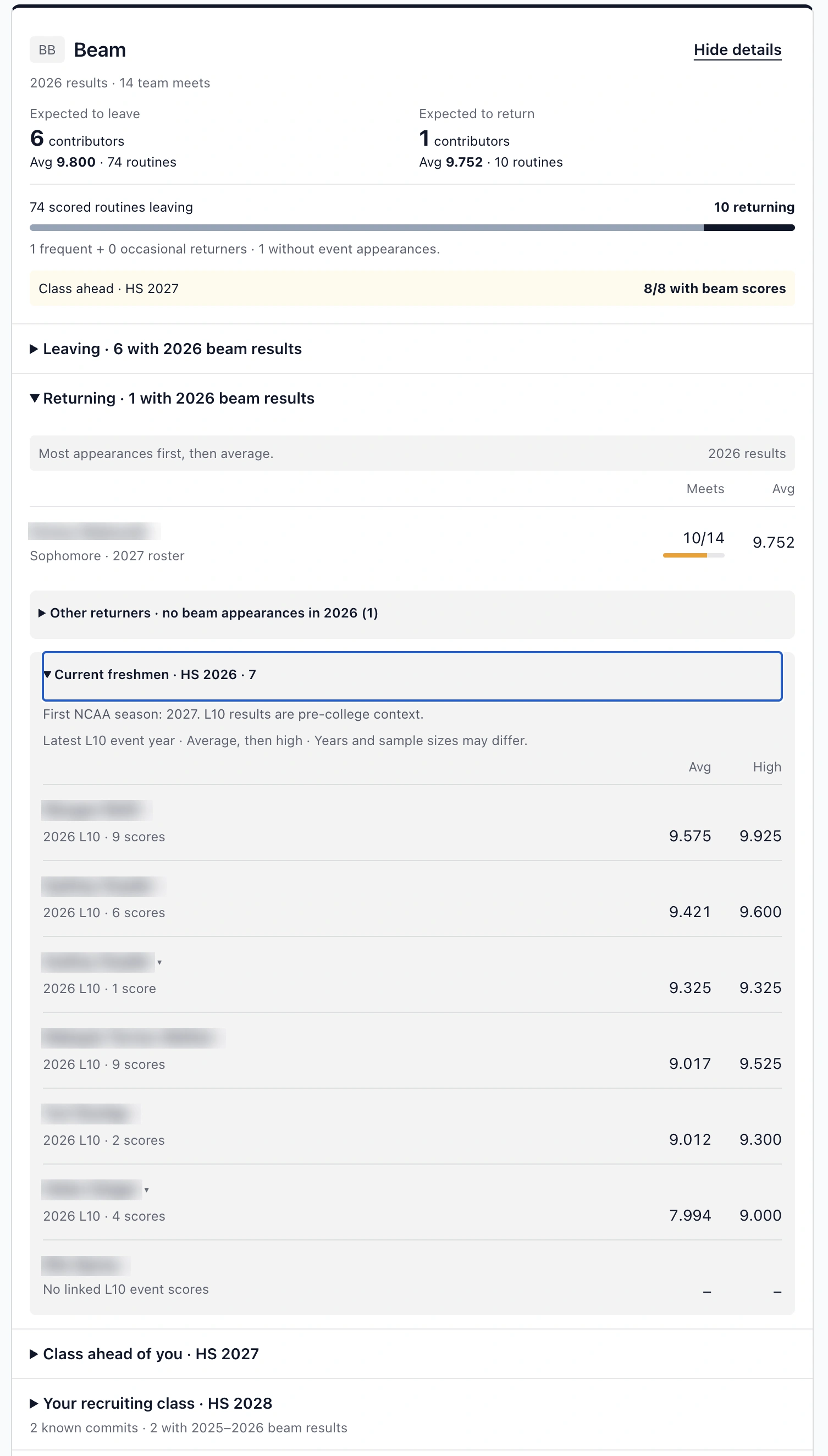
Count experience. Leave room for potential.
Here, one athlete with recorded 2026 beam appearances is expected to return under the default assumptions. Another returning athlete has no beam appearances in that results season.
Now look beyond that historical snapshot. Current NCAA-rostered freshmen have separate Level 10 context, before their first college results are available. No recorded NCAA appearances does not mean no potential.
THE BETTER QUESTION
How much proven event experience returns, and what depth could still develop?
No recorded appearances ≠ no potential
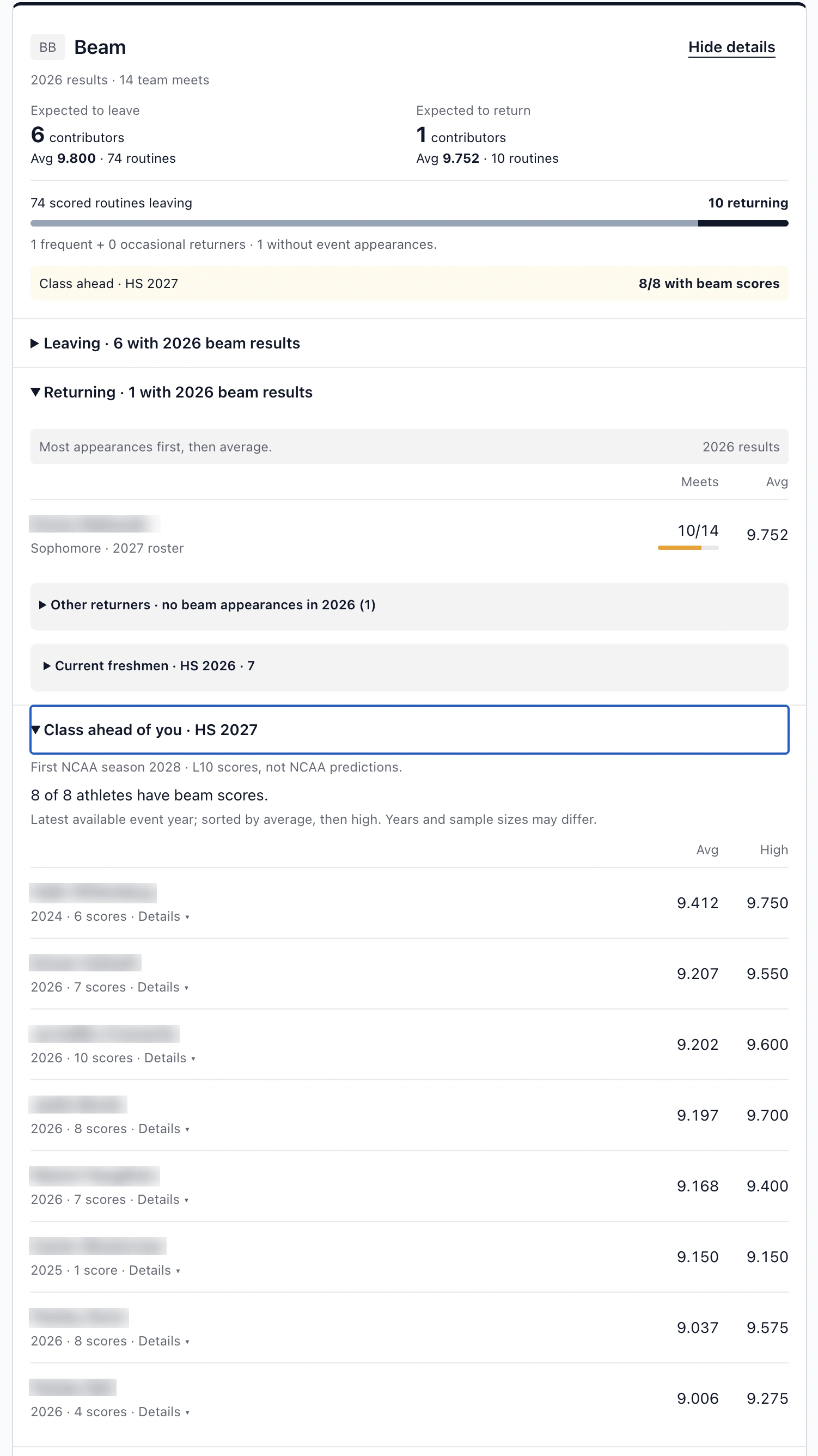
Before you see a gap, look who’s coming.
Now add the class ahead: eight athletes in the HS 2027 group have recorded Level 10 beam scores. They arrive before this HS 2028 recruit.
Check the season and sample size. These are Level 10 results, not predictions of NCAA scores or future lineup positions.
THE BETTER QUESTION
How might the class ahead change the event picture before I arrive?
HS 2027 class ahead · Not NCAA predictions
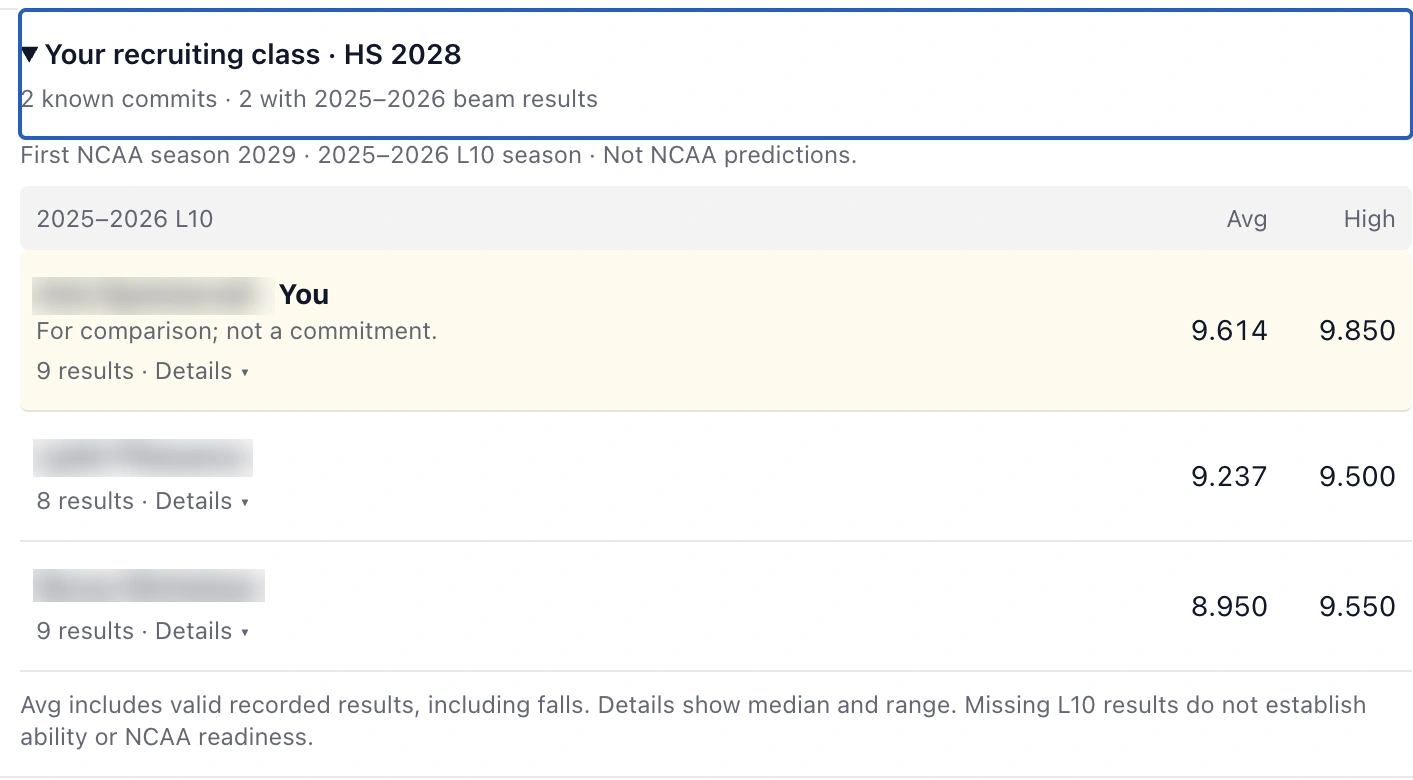
Your class. Your own scores in context.
Compare your recorded event scores with available scores for known commits in your graduation year at this school.
This example shows two known HS 2028 commits alongside the recruit’s own beam history. Her comparison row is not a commitment. It does not represent every athlete pursuing the school.
THE BETTER QUESTION
How do my event strengths compare with the class taking shape?
Screenshots are supplied examples, not a live feed. Selected assumptions describe possible future participation, not confirmed recruiting availability.
EXPLORE THE UNCERTAINTY
What if she stays another year?
Try a potential fifth-year return or departure and see which recorded event experience is included in your scenario.
The athletes change. Their recorded scores don’t. A fifth-year choice is a research assumption, not confirmation of eligibility or a decision to return.
Clemson · HS 2028 example · Two choices active in this separate screenshot. The walkthrough above uses defaults.
Make the assumption explicit
MORE THAN A SCORE
On vault, the skill matters too.
A vault average tells you one thing. Knowing the reported vault gives you another piece of the research.
Where available, explore the reported vault alongside an incoming athlete’s Level 10 history. Check its source and date, then discuss the skill context with your coach.
A reported vault is not a verified current routine, a start-value assessment, or a prediction of college readiness.
Clemson · Reported skill context, not a readiness guarantee
ONE PART OF YOUR WHOLE RECRUITING JOURNEY
Research the fit. Then put it to work.
Use Athletic Fit to put your scores in context. Explore estimated roster spots for your arrival year. Add Lineup Explorer to understand the event picture.
Instead of piecing together rosters, results, class years, and incoming athletes across separate sources, work through a connected picture. Then bring that research into your outreach, conversations, visits, and next steps.
Yorra keeps it together in one personalized recruiting portal. Go from “I like this school” to “I understand why I’m pursuing it.”
Review the event picture with your club coach or recruiter to discuss your development and where to focus your effort. Ask the college coaching staff about their recruiting priorities and how they see your potential contribution.
Those are different conversations. Yorra helps you prepare for both; the research does not establish what a college program is looking for or replace either conversation.
Is this only for the graduation year shown?
No. Your high school graduation year sets the arrival timeline you research. The main walkthrough uses HS 2028, whose first NCAA season is 2029. The same research questions matter for other classes. Longer-range views carry more uncertainty because future roster changes and athlete development are not yet known.
Does a departure mean there’s an opening for me?
No. Returning athletes, incoming recruits, transfers, and coaching decisions all affect the picture. A departing contributor does not create a guaranteed roster or lineup position. Confirm recruiting opportunities directly with the coaching staff.
Are you predicting NCAA scores or lineups?
No. Recorded NCAA results describe past contributions. Incoming athletes’ Level 10 results offer separate context, not converted NCAA scores. Skills, start values, routine composition, NCAA requirements, health, and development all matter.
What if an athlete has no event scores?
No recorded appearances or missing scores should not be read as no ability. Use coverage notes, result years, and sample sizes to understand what the data can and cannot tell you.
How should I use this with my coach or recruiter?
Bring a school, your arrival year, and your strongest events. Use the evidence to discuss where to focus your effort, what to highlight, and which questions to ask the college staff. The research supports their judgment; it doesn’t replace it.
HS 2027 examples · First NCAA season 2028
Your year. The class taking shape.
For an HS2027 recruit, the research looks toward her first NCAA season in 2028. Compare her own event history with the available results of known commits in that class.
In this separate beam example, the recruit’s recorded average and high are above both shown commits. That is useful context for a conversation, not a ranking of recruiting prospects or a prediction of college contribution.
The “You” row is for comparison, not a commitment. The full screen retains the recorded-results coverage and roster-timing caveats.
HS2027 → NCAA2028 · Separate example · Names hidden
Another school. The same research process.
This Yale overview is a different HS2027 example. It shows how event experience and class-ahead context can vary across a team.
The display states its Ivy default of no assumed fifth-year extension and flags incomplete roster reconciliation. Keep those limitations in the research rather than treating unverified absences as departures.
Yale · Separate HS2027 overview · Click to inspect
Your same-class comparison is available now. In-season result updates remain in development.
IN DEVELOPMENT
In-season result updates.
We’re building in-season result updates so you can revisit the schools on your list as new performances add to the picture.
The goal: less rebuilding your research, and more context on who is contributing, how often, and on which events.
Refresh timing will be confirmed as the in-season workflow is tested.
Clemson screenshots updated September 25, 2026. Recorded results and selected assumptions are research context, not confirmed future lineups or recruiting opportunities. Athlete names hidden in public examples. Athletes and schools shown do not imply endorsement.